
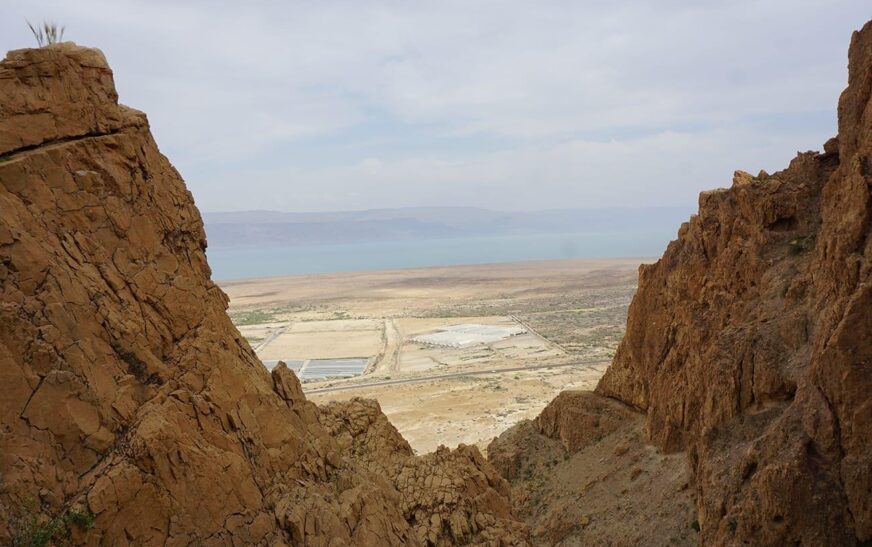
A cheap metal detector sat in my garage for two years before I finally used it. My neighbor talked me into trying it out on a Saturday morning in a nearby field. Twenty minutes in, a rusty old coin buzzed under the coil, and I nearly tripped over my own feet running to dig it up.
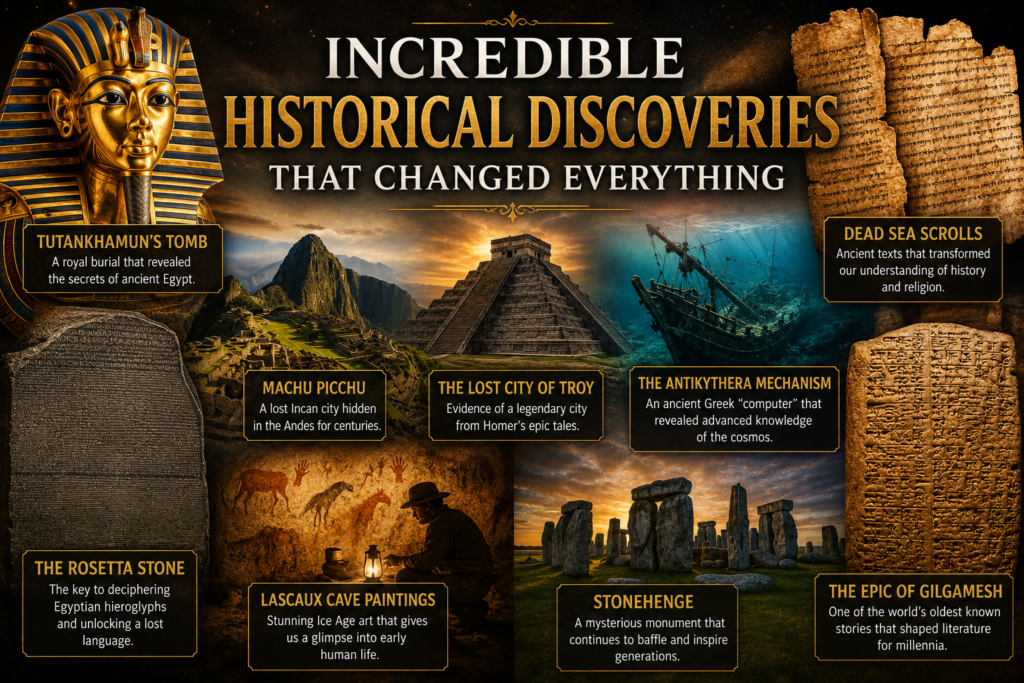
That coin turned out to be worth about three dollars. It didn’t matter. Something about pulling a piece of the past out of the dirt with my own hands flipped a switch in my brain.
I went home and fell into a YouTube hole about actual historical discoveries, the kind that end up in museums instead of a Ziploc bag on my kitchen counter. A few hours turned into a few years of reading about this stuff, and I’ve never quite recovered.
This article covers the discoveries that genuinely reshaped how we understand history, plus what I learned chasing my own much smaller version of that same obsession.
Why Random Discoveries Matter More Than People Realize
Most people think history gets written once and stays that way. It doesn’t.
Entire timelines shift when someone digs up the right object in the right place. Textbooks get rewritten. Assumptions that stood for centuries collapse overnight. A farmer, a shepherd, or a bored teenager stumbles onto something, and suddenly historians everywhere scramble to update what they thought they knew.
That unpredictability is what hooked me. Big institutions with massive funding don’t always make the biggest finds. Regular people with dumb luck do it constantly.
The Rosetta Stone: The Key That Unlocked Ancient Egypt
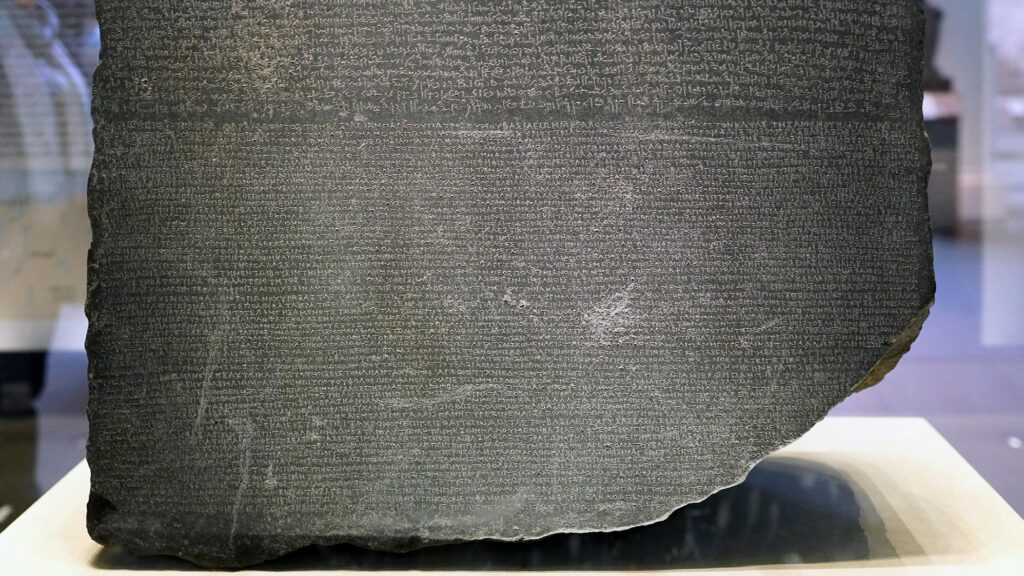
French soldiers found a broken slab of black granite near the town of Rosetta in Egypt back in 1799, and nobody realized yet what they’d stumbled onto.
The stone contained the same decree written in three scripts: Greek, Egyptian hieroglyphics, and Egyptian demotic script. Scholars could already read Greek. That gave them a way in.
Jean-François Champollion cracked the code in 1822 after years of obsessive work comparing the scripts side by side. Egyptian hieroglyphics had stumped scholars for over a thousand years before that breakthrough. Suddenly, thousands of tombs, temples, and papyri became readable.
I saw the actual stone at the British Museum a few years back, and honestly, it looks smaller in person than you’d expect. A crowd surrounds it constantly, and everyone seems to have the same reaction. This chunk of rock unlocked an entire civilization’s written history.
Why This One Still Matters
Without the Rosetta Stone, most of what we know about ancient Egyptian religion, government, and daily life would still sit locked behind an unreadable script. One lucky find changed an entire field of study.
Tutankhamun’s Tomb: The Discovery That Never Gets Old
Howard Carter spent years searching the Valley of the Kings before his funding nearly ran dry in 1922. His backer, Lord Carnarvon, gave him one final season to find something worthwhile.
Carter’s team found steps leading to a sealed doorway that November. Carnarvon rushed to Egypt, and together they broke through into the antechamber. Carter reportedly peered through a small hole with a candle, and Carnarvon asked if he could see anything.
“Yes, wonderful things,” Carter answered.
The tomb held over 5,000 artifacts, nearly untouched by looters for over 3,000 years. Golden funerary masks, chariots, jewelry, and furniture filled the chambers. This remains one of the only royal Egyptian tombs found almost completely intact.
Why This One Still Matters
Tutankhamun himself was a relatively minor pharaoh who died young. His tomb became legendary purely because grave robbers missed it for three millennia. It gave archaeologists an unprecedented look at how Egyptian royalty actually lived, not just how they wanted to be remembered.
The Dead Sea Scrolls: A Shepherd’s Accidental Discovery
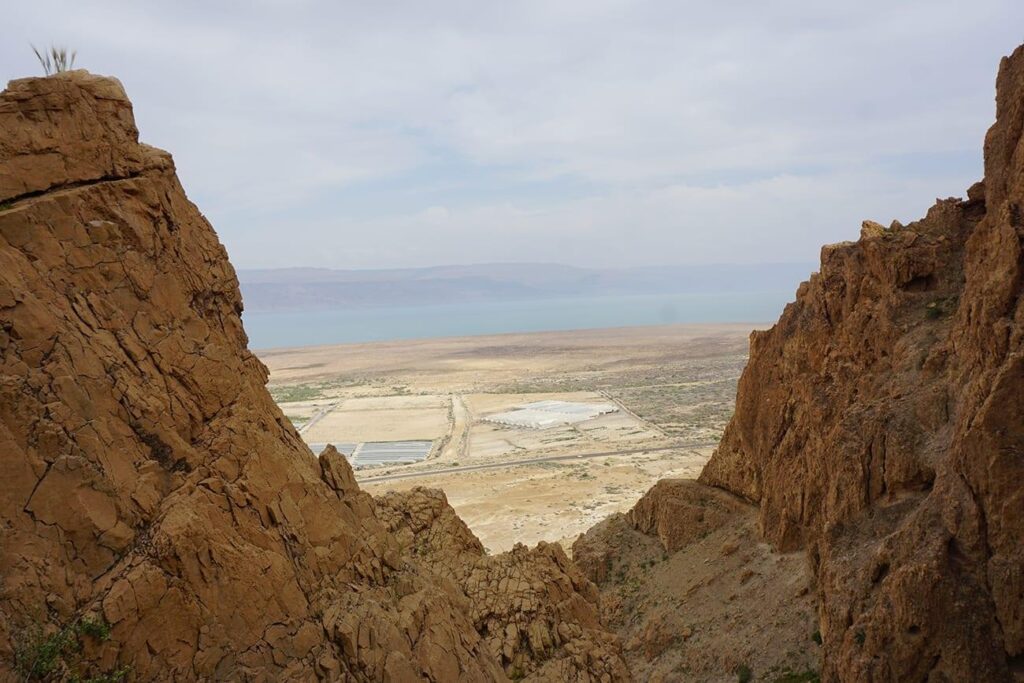
A Bedouin shepherd named Muhammed edh-Dhib went looking for a lost goat near the Dead Sea in 1947. He threw a rock into a cave opening out of curiosity and heard something shatter.
Inside, he found ancient clay jars containing scrolls wrapped in linen. Those scrolls turned out to be among the oldest known copies of Hebrew biblical texts, some dating back over 2,000 years.
Researchers eventually recovered around 900 manuscripts from multiple caves in the area. The scrolls include portions of nearly every book in the Hebrew Bible, along with other religious and historical texts that had never been seen before.
I read a detailed breakdown of the discovery process once, and the part that stuck with me involved black market dealers. Some scroll fragments got sold piece by piece before scholars even knew the full scope of what existed. Researchers spent decades tracking down scattered pieces afterward.
Why This One Still Matters
The scrolls gave biblical scholars a way to compare ancient texts against much later versions of the same documents. They confirmed some passages stayed remarkably consistent over two millennia and revealed other differences historians hadn’t expected.
The Terracotta Army: Farmers Digging a Well
A group of farmers in China’s Shaanxi province started digging a well in 1974 during a drought. Instead of water, their shovels hit clay.
That clay turned out to be the head of a life-sized soldier, part of an army of more than 8,000 figures buried to guard Emperor Qin Shi Huang in the afterlife. Archaeologists later found horses, chariots, and weapons alongside the soldiers, each figure carved with individual facial features.
The farmers had no idea what they’d found at first. Local officials eventually got involved, and the site grew into one of the most significant archaeological excavations of the twentieth century.
I visited a traveling exhibit featuring a handful of the actual statues years ago. Standing close enough to see individual expressions on each soldier’s face made the whole thing feel less like ancient history and more like staring at real people frozen mid-moment.
Why This One Still Matters
Nobody expected an emperor’s tomb complex on this scale to survive undiscovered for over two thousand years. It reshaped how historians understood Qin dynasty craftsmanship, military organization, and burial practices.
The Antikythera Mechanism: A Computer From 100 BCE
Greek sponge divers found a shipwreck off the coast of Antikythera island in 1901 while searching for sponges in unusually deep water.
Among the wreckage sat a corroded lump of bronze that nobody paid much attention to at first. Decades later, researchers realized it contained an intricate system of gears designed to track astronomical positions and predict eclipses.
Scientists used X-ray imaging in the 2000s to map the internal gear structure without damaging the fragile artifact. What they found stunned them. Nothing built with this level of mechanical complexity appeared again until clockwork devices emerged in medieval Europe, over a thousand years later.
Why This One Still Matters
This single object forced historians to rethink how advanced ancient Greek engineering actually was. A civilization we associate mostly with philosophy and marble statues apparently built something resembling an analog computer.
Machu Picchu: Rediscovering What Locals Never Forgot
Yale historian Hiram Bingham gets credit in most textbooks for finding Machu Picchu in 1911, but that framing skips an important detail. Local Peruvian farmers already knew the site existed and led Bingham directly to it.
The Inca built this mountaintop city around 1450, and it sat largely untouched by Spanish conquistadors during their conquest of the region. Dense jungle growth kept it hidden from wider outside attention for centuries.
Bingham’s expedition brought global publicity to the site through National Geographic, which funded much of the excavation work. That publicity turned Machu Picchu into one of the most visited archaeological sites on the planet.
I finally made the trip myself a couple of years ago, and no photo prepares you for how the terraces wrap around the mountainside. Altitude sickness hit me harder than the hike did, honestly. Bring water and take the acclimatization days seriously if you ever go.
Why This One Still Matters
Machu Picchu reshaped how the world understood Inca engineering and urban planning. The site’s irrigation systems, agricultural terraces, and construction techniques still impress engineers who study it today.
Ötzi the Iceman: A 5,300-Year-Old Murder Mystery
Two German hikers spotted a body poking out of melting ice in the Ötztal Alps in 1991. They initially assumed it belonged to a modern mountaineer who died in an accident.
Forensic examination revealed something far stranger. The body dated back roughly 5,300 years, making it the oldest naturally preserved human mummy ever found in Europe. Researchers named him Ötzi after the mountain range.
Scientists found an arrowhead lodged in his shoulder, along with defensive wounds on his hands. Ötzi didn’t die of exposure. Someone killed him, and the mystery around exactly why still isn’t fully solved.
His equipment told its own story. Researchers found a copper axe, a bow, arrows, and even evidence of tattoos on his preserved skin, giving scientists a genuinely detailed look at Copper Age tools and technology.
Why This One Still Matters
Ötzi gave researchers an incredibly rare, nearly complete snapshot of daily life, diet, and even violence from a period with almost no written records. His stomach contents alone revealed what people actually ate five thousand years ago.
Pompeii: A City Frozen in a Single Afternoon
Mount Vesuvius erupted in 79 CE and buried the Roman city of Pompeii under volcanic ash within hours. The eruption killed thousands of residents almost instantly.
Excavations beginning in the 1700s revealed something eerie. Ash preserved the city in remarkable detail, including bread still sitting in ovens and political graffiti scratched onto walls. Voids left by decomposed bodies allowed archaeologists to pour plaster into the cavities, creating haunting casts of victims in their final moments.
I walked through the ruins on a trip a few years back, and the detail genuinely unsettled me. You can still see wheel ruts worn into the stone streets from Roman cart traffic. It doesn’t feel like a museum. It feels like a paused film.
Why This One Still Matters
Pompeii gave historians an unprecedented, frozen-in-time look at ordinary Roman daily life, not just the lives of emperors and senators. Nothing else compares to it in terms of everyday detail preserved at this scale.
Common Mistakes People Make When Learning About These Discoveries
I’ve picked up on a few recurring problems after years of reading into this stuff.
People assume big discoveries only happen through formal expeditions. Farmers, shepherds, hikers, and sponge divers made several of history‘s most important finds completely by accident.
People trust dramatized documentaries over peer-reviewed sources. Streaming platforms love mystery angles and conspiracy framing. Actual archaeological journals usually tell a more grounded, and often more interesting, version of events.
People skip the controversy around who gets credit. Machu Picchu is a perfect example. Bingham gets textbook credit despite local farmers already knowing about the site. Understanding this context matters.
People forget how much luck plays into archaeology. A drought led to the Terracotta Army. Melting ice revealed Ötzi. A lost goat led to the Dead Sea Scrolls. Skill matters, but timing and chance matter just as much.
People treat these discoveries as finished stories. Researchers still study the Antikythera mechanism today using updated imaging technology. New findings keep emerging from sites people assumed were fully explored decades ago.
How to Explore Historical Discoveries Yourself
Here’s the process that worked for me, broken into steps you can actually follow.
Step one: start with a documentary that cites real archaeologists. Look for series produced with actual research institutions attached, like anything featuring the Smithsonian Channel or BBC archaeology documentaries, rather than random streaming content with dramatic narration and thin sourcing.
Step two: use Google Arts & Culture to view artifacts up close. Many museums, including the British Museum and the Egyptian Museum in Cairo, have partnered with the platform to offer free, zoomable, high-resolution photos of items you’d never get close enough to examine in person.
Step three: follow archaeology news through a dedicated source. Archaeology Magazine and the Smithsonian Magazine website both post regular updates on new digs and reanalyzed artifacts, which keeps you current instead of stuck on decades-old information.
Step four: visit a natural history or archaeology museum near you. You don’t need international travel. Regional museums often hold surprisingly strong collections, and standing in front of a real object changes how the story lands compared to a photo.
Step five: try a local metal detecting or amateur archaeology club if you’re curious hands-on. Check local regulations first, since digging on protected or historical land usually requires permits. Most clubs know the legal boundaries and can point you toward approved sites.
Step six: read one detailed book on a single discovery instead of skimming ten shallow articles. “The Discovery of King Tut” by Zahi Hawass and “Iceman” by Brenda Fowler both go deep on a single find rather than skimming across dozens of surface-level facts.
Step seven: keep a running notes file for context you pick up along the way. I use a simple Notion page to track dates, names, and locations as I read. Cross-referencing later gets much easier once you build that habit.
Real Examples From My Own Digging Around
That first metal detecting coin sent me chasing bigger stories, but it also taught me a hard lesson early on.
I once found what looked like an old buckle in a field and got genuinely excited, convinced I’d stumbled onto something significant. A local historical society volunteer took one look and told me it was a tractor part from the 1960s. Mildly humbling, but it taught me to slow down and actually research finds instead of assuming every rusty object holds historical value.
Another example: reading about the Antikythera mechanism sent me down a research spiral into ancient Greek astronomy, which led me to a documentary on the mechanism’s digital reconstruction, which led me to a university research paper explaining the gear ratios in detail. One curiosity chain led to genuinely understanding something I never expected to care about.
Final Thoughts
What sticks with me most after years of reading about these finds isn’t really the gold masks or the ancient computers. It’s how often ordinary people stumbled into extraordinary history completely by accident.
A shepherd chasing a goat. Farmers digging a well during a drought. Sponge divers working in deep water. None of them set out to rewrite history books, yet that’s exactly what happened.
If a rusty three-dollar coin in a random field got me hooked on this stuff, imagine what a trip to an actual museum or dig site might do for you. Go look at something real when you get the chance. Photos online are fine, but standing next to an object that survived thousands of years hits differently, and that feeling is worth chasing.