


Three years into running my first business, I hired someone I shouldn’t have. Ignored every red flag during the interview because I was desperate to fill a role. Paid for that decision for eight months before finally letting them go.
That mistake cost me clients, time, and a chunk of money I didn’t have to spare.
Looking back, that wasn’t really a hiring problem. It was a judgment problem. And judgment, it turns out, is something you can only build through experience, observation, and occasionally getting things badly wrong.
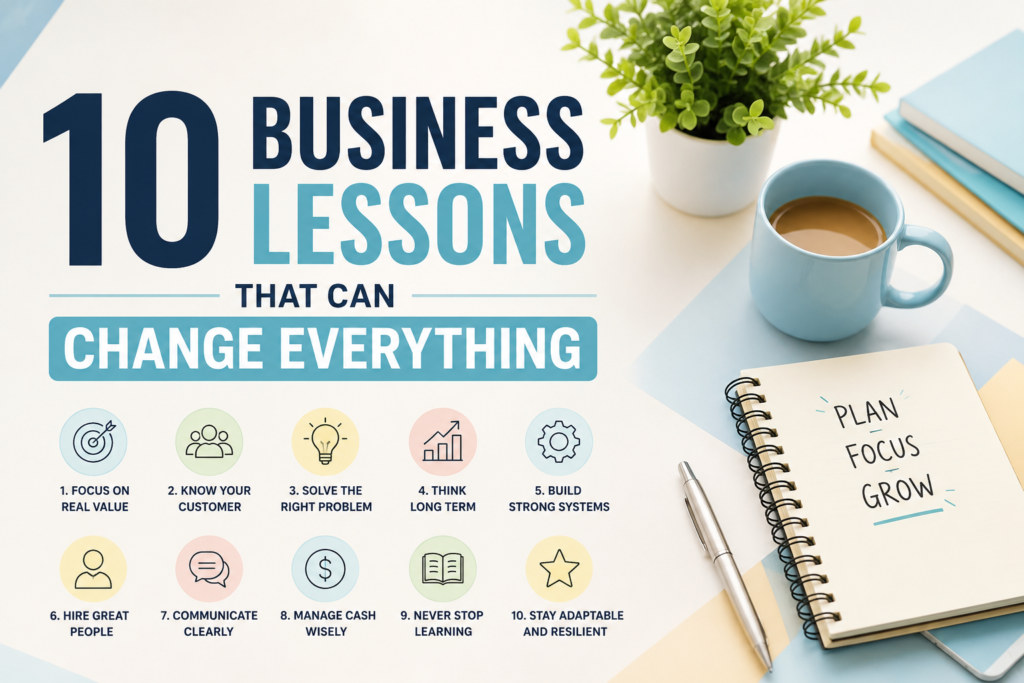
What follows are ten lessons I’ve collected from running businesses, watching others run theirs, and spending more time than I care to admit reading about what separates companies that grow from ones that quietly disappear. None of these are theoretical. All of them came with a price tag, either mine or someone else’s.
Lesson 1: Cash Flow Matters More Than Profit
Most people starting a business fixate on profit. Understandable. Profit sounds like success. Cash flow sounds like accounting homework.

Here’s the thing though. A profitable business can still go under. Profit tells you what you made. Cash flow tells you what you actually have available right now to pay your team, your suppliers, and your rent.
Plenty of businesses fail while technically profitable because money owed to them hasn’t arrived yet. Clients delay payments. Projects stretch beyond expected timelines. Suppliers demand payment before revenue comes in. The gap between profit on paper and money in the bank is where businesses quietly die.
Tracking cash flow weekly changed how I made decisions. Simple tools like QuickBooks, Wave, or even a basic spreadsheet showing money in versus money out that week force a level of clarity that monthly profit reports miss entirely.
What to Actually Do
Project your cash flow three months forward. Write down what you expect to receive and when. Note every payment going out too. Look at what the bank balance looks like at the end of each week in that projection.
Do this exercise before you feel like you need to. Most people only start paying attention to cash flow after a crisis. Starting earlier means the crisis often never arrives.
Lesson 2: Your First Customers Are Your Most Important Teachers
Every business starts with assumptions about what customers want. Some of those assumptions are right. Many are wrong in ways you can’t predict from a spreadsheet.

Early customers tell you what you actually built versus what you thought you built. Their complaints reveal friction you didn’t know existed. Early enthusiasm from customers points toward the aspects of your offering worth doubling down on.
A software founder I know launched a project management tool convinced users wanted powerful reporting features. First fifty customers barely touched the reports. Every single one kept mentioning how much they loved the simple task assignment interface. She spent six months building features nobody used while the thing people genuinely valued sat there half finished.
Paying attention to behavior rather than stated preferences matters here. What people say they want and what they actually use regularly are sometimes very different things.
How to Listen Properly
Set up brief calls with your first ten to twenty customers. Don’t pitch anything. Just ask what brought them to your product, what they use most, and what frustrates them.
Record those calls with permission using tools like Otter.ai or Zoom’s built in recording. Play them back later. Patterns emerge across multiple conversations that aren’t obvious in the moment.
Lesson 3: Saying No Is a Business Strategy
Early stage businesses say yes to almost everything. Makes sense at first. Revenue is scarce. Opportunities feel precious. Turning down work feels counterintuitive when you’re trying to grow.

At some point though, saying yes to the wrong things starts costing more than saying no would have. The wrong client drains energy from the right ones. Accepting the wrong project pulls your team away from building things that actually matter. Signing a partnership that doesn’t fit creates obligations that outlast their usefulness.
One of the clearest signals a business is maturing is when it gets comfortable turning things down. Not arrogantly. Deliberately. With a clear sense of what fits their actual strengths and where they create the most value.
Warren Buffett talks about this in terms of an investment framework. Not every opportunity deserves a yes just because it’s available. The same logic applies to clients, partnerships, and product features.
Lesson 4: Reputation Travels Faster Than Marketing
Spending money on ads, social media content, and SEO matters. None of it matters as much as what people say about you when you’re not in the room.

Word of mouth still drives more business than most marketing budgets. One unhappy client who talks freely about a bad experience with your company undoes weeks of carefully crafted content. A single genuinely delighted client who mentions you to three colleagues can be worth more than a month of paid advertising.
Reputation isn’t built through grand gestures. Returning calls promptly, delivering slightly ahead of deadline, following up when something goes wrong without being asked, these small consistent behaviors accumulate over time into something that marketing can’t easily manufacture.
This is especially true in smaller industries where everyone seems to know each other. Being known as someone who does exactly what they say they’ll do is worth protecting more than almost any other business asset.
Lesson 5: Hire for Character First, Skills Second
Skills can be taught. Work ethic can be improved with the right environment. Character, the underlying way someone treats people and handles adversity, is much harder to change in an adult.

Going back to that hiring mistake I mentioned at the start. The red flags weren’t about skills. His resume was genuinely impressive on paper. Every warning sign was behavioral instead. Subtle dismissiveness in certain answers. Inconsistencies in how they described previous situations. A pattern of placing blame externally in every story about something that went wrong.
None of that shows up in a skills assessment. All of it showed up every single day once they joined the team.
A Simple Interview Shift
Ask candidates to walk you through a time they failed at something professionally. Listen for self awareness rather than a polished pivot to something positive. People who can genuinely reflect on their own mistakes without excessive defensiveness tend to be the ones who learn, adapt, and make your team better over time.
Also pay attention to how candidates treat people they have no reason to impress. Receptionists, assistants, people in the office who aren’t part of the interview panel. That behavior is far more revealing than anything said directly to you.
Lesson 6: Systems Beat Talent Over the Long Run
Talented individuals can carry a business for a while. Systems are what let businesses scale beyond what any individual can carry.

McDonald’s is the most cited example because it works so well. Their food isn’t universally loved. Operational systems, however, produce consistent results across tens of thousands of locations because the process is documented, repeatable, and doesn’t depend on any single person being brilliant on any given day.
Within smaller businesses, the version of this is documenting how things get done. Creating checklists for recurring tasks. Building templates for common communications. Recording video walkthroughs of processes using tools like Loom. Every time you do something more than twice, ask whether it could be systematized so someone else could handle it just as well.
Businesses that depend entirely on the founder’s involvement in every decision don’t scale. They clone. The founder just gets reproduced in every task rather than building something that runs independently.
Lesson 7: Data Should Inform Decisions, Not Replace Them
Analytics dashboards, customer data, conversion rates, engagement metrics. All valuable. None of them tell you everything.

Data shows what happened. It rarely explains why with full accuracy. Understanding the why behind numbers requires conversations, context, and judgment that no spreadsheet provides automatically.
A retail client I worked with once cut their entire budget for in-store product demonstrations because conversion data showed those events performed below average. Revenue dropped noticeably in the months that followed. Post-event customers had a dramatically higher lifetime value than average, something the original metric hadn’t captured.
The data was accurate. Its interpretation, however, missed something important. Good business decisions treat data as input, not output. Numbers open questions as often as they answer them.
Lesson 8: Speed of Learning Matters as Much as Speed of Execution
Moving fast is praised constantly in business culture. Failing fast gets celebrated too. Neither speed of action nor speed of failure is actually the point.

Speed of learning is what matters. How quickly does your business notice something isn’t working? What speed does that information reach the people who can actually change course? More importantly, how effectively does the organization incorporate what it learned into the next attempt?
Companies that learn quickly from both success and failure compound their knowledge over time. Businesses that move fast but don’t extract lessons from experience just repeat expensive mistakes with more efficiency.
Building a simple habit of reviewing what worked and what didn’t after every significant project, campaign, or quarter costs almost nothing. The returns accumulate faster than most other investments a business can make.
Lesson 9: Your Network Is a Living Asset, Treat It That Way
Relationships built only when you need something from people aren’t really relationships. They’re transactions disguised as connections, and most people on the receiving end can feel the difference.

Genuinely useful professional networks get built through consistent, low stakes interaction over time. Sharing something useful without expecting anything back. Introducing people to each other when you spot a connection they’d benefit from. Following up on conversations months later just to see how something worked out.
These behaviors don’t produce immediate returns. Over three to five years though, a network built this way becomes one of the most valuable things any business person possesses. Job leads, client referrals, honest advice from people you trust, access to experts who take your call because they remember you as someone worth helping.
LinkedIn works fine for maintaining these connections at scale. Real relationships still get built through direct messages, emails, phone calls, and occasionally meeting in person. LinkedIn is simply the address book that holds it all together.
Lesson 10: Protecting Your Energy Is a Business Decision
Burnout isn’t a personal failure. Running at maximum capacity for extended periods produces diminishing returns that eventually turn negative.

Decision quality degrades when mental energy is depleted. Creativity drops. Patience with clients, employees, and partners gets thinner. Small problems start feeling like large ones. Risk assessment skews toward either excessive caution or reckless overconfidence depending on how exhaustion affects your particular psychology.
Managing energy doesn’t require elaborate wellness routines. Protecting blocks of uninterrupted time for deep work. Leaving genuine space for rest without guilt. Noticing when performance is slipping and taking it seriously rather than pushing harder through the problem.
Some of the best business decisions I’ve watched people make came during or shortly after a period of rest. The perspective that distance creates is genuinely productive, not a luxury to feel guilty about.
Common Mistakes That Get in the Way of These Lessons
Even knowing these lessons doesn’t guarantee applying them. A few patterns show up repeatedly in why people struggle to put good principles into practice.
Waiting for perfect information before deciding. Most business decisions need to be made with incomplete data. Waiting for certainty that never arrives is itself a decision, usually a costly one.
Confusing activity with progress. Staying extremely busy feels productive. Productive feels like success. Busy and productive are not the same thing. Reviewing whether your busiest activities are your highest value ones periodically is worth doing.
Avoiding hard conversations too long. Whether with a struggling employee, a client relationship that isn’t working, or a partner whose direction has diverged from yours. Delay almost always makes these conversations more expensive when they finally happen.
Underestimating how long things take. Project timelines, hiring processes, building a customer base, changing a company culture. Almost all of these take longer than initial estimates suggest. Planning for longer reduces the stress and poor decisions that come from feeling perpetually behind.
Treating every setback as a signal to quit. Failure within a business isn’t the same as the business failing. Distinguishing between data about what needs to change and a verdict on whether to continue requires honest self-assessment rather than emotional reaction.
Tools Worth Having in Your Corner
Good business instincts develop faster with the right support around them.

Notion works well as a central place to document processes, track projects, and keep institutional knowledge in one accessible location. Teams that write things down perform differently than teams that keep everything in people’s heads.
Slack or Microsoft Teams reduce the volume of back-and-forth email on daily operational tasks. Both free up mental space for more substantive work.
Calendly removes the tedious scheduling back-and-forth that eats more time than most people track carefully. Small friction reductions compound across a year into meaningful hours reclaimed.
Reading broadly beyond your own industry consistently produces unexpected insights. Books like The E-Myth Revisited by Michael Gerber, Zero to One by Peter Thiel, or Thinking in Bets by Annie Duke each offer frameworks that outlast any single tactic or trend.
Final Thoughts
None of these ten lessons requires a business degree to understand. Most of them require something harder than education. They require the willingness to look honestly at what’s working, what isn’t, and why.
Every business that grows past its early stage does so by accumulating judgment. Judgment comes from experience. Experience includes mistakes, recoveries, unexpected wins, and quiet failures that never make it into anyone’s success story.
The gap between knowing something and actually doing it is where most business advice lives and dies. Pick one lesson from this list that applies to something you’re dealing with right now. Apply it specifically to that one situation. See what changes.
That’s where the real learning starts.